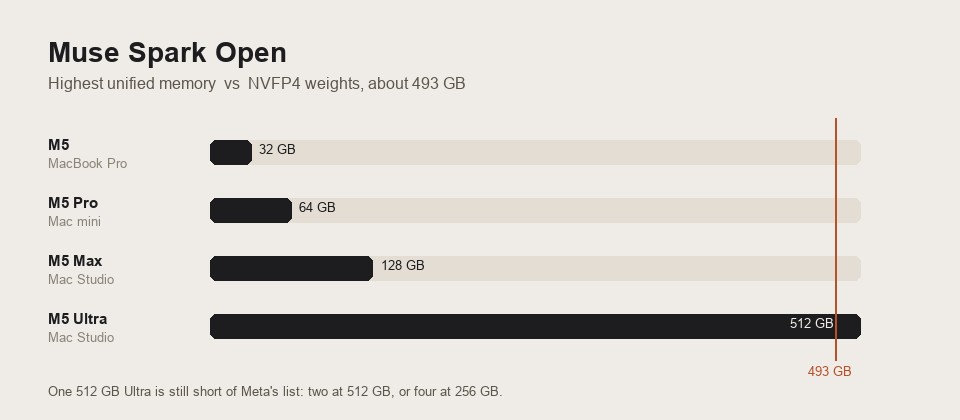
People keep asking whether Muse Spark Open fits on a Mac mini, and almost nobody starts by separating the chip name from the memory that is soldered to that machine. This piece sets the memory bar Meta published for Apple hardware, lines up unified memory on M5, M5 Pro, M5 Max, and M5 Ultra, and only then maps those ceilings onto the Mac mini you can buy today.
Figures checked on 16 October 2026. The model bar comes from Meta's hardware-platform page, the MLX cookbook, and the research post. Chip tiers come from Apple's Mac mini tech specs, the Mac Studio support page, and the 14-inch MacBook Pro (M5) support page.
Capacity is the first gate on a Mac
On 15 October 2026 Meta released the weights for Muse Spark Open, a natively multimodal mixture-of-experts model: 816B parameters in total, about 42B active per token, and a 1 million token context window. That is a different product from the personal agent named Muse, which Meta introduced in September and runs inside a dedicated virtual machine. Muse Spark Open is a downloadable checkpoint. A separate post on this site covers the agent product; the hardware bill for one does not apply to the other. (What OpenAI Dots and Meta Muse mean for developers)
The Apple path is spelled out on Meta's hardware-platform page. The checkpoint is meta-models/Muse-Spark-Open-816B-A42B-NVFP4, the runtime is MLX, and the machine is a Mac Studio with M5 Ultra. The two published layouts are two Studios with 512GB of unified memory each, or four with 256GB each. The same day, MacStories reported that even the 4-bit version needs about 493GB of memory.
Active parameters and total parameters answer different questions. At roughly 4 bits, the 42B slice a single token actually reads is about 21GB. The full 816B at 4 bits is about 408GB. The reported 493GB is larger than 408GB because scales, embeddings, and runtime buffers are still sitting in memory. Bandwidth decides how fast that slice is read. Capacity decides whether the whole package fits in unified memory. The M5 Ultra's 1.2TB/s is what Meta is pointing at when it says the chip can read the small slice each token needs. It does not make a machine with a few tens of gigabytes large enough.
Two names, two products
Muse Spark Open is the open-weight model released on 15 October. September's Muse is a personal agent, and Muse Code is a coding agent aimed at the terminal and CI. The desktop demo in the research post drives Muse Code with these weights, on a Mac Studio, through an iOS change and a video edit. That is a model plus software, not a feature that ships on a Mac mini.
Unified memory across the four chips
The tiers below are the ones still listed on Apple's spec pages. Base M5 comes from the 14-inch MacBook Pro (M5) support page. The Mac mini ceiling for M5 Pro comes from the Mac mini tech specs. M5 Max and M5 Ultra come from the Mac Studio support page. Unified memory is soldered. You do not add it later.
| Chip | Unified memory | Bandwidth | Where that tier ships | Against ~493GB |
|---|---|---|---|---|
| M5 | 16 / 24 / 32GB | 153GB/s | 14-inch MacBook Pro and related products. No base M5 on the current Mac mini shelf | Top tier about 6% |
| M5 Pro | 24 / 48 / 64GB on Mac mini | 307GB/s | The Pro Mac mini now on sale: 15-core CPU / 16-core GPU, or 18-core / 20-core | Top tier about 13% |
| M5 Max | 36GB, or 48 / 64 / 128GB | 460GB/s, or 614GB/s | Mac Studio. 36GB comes with the 32-core GPU; 48GB and up require the 40-core GPU | Top tier about 26% |
| M5 Ultra | 96GB, or 256 / 512GB | 1.2TB/s | Mac Studio only. 256GB and 512GB require the 36-core CPU / 80-core GPU | One 512GB machine sits just above 493GB; Meta still lists two |
The percentages divide that chip's highest listed capacity by 493GB. They are an order-of-magnitude check. On M5 Max, 128GB is tied to the 40-core GPU at 614GB/s. The 32-core GPU stops at 36GB and 460GB/s. On M5 Ultra, 256GB and 512GB are tied to the 80-core GPU. The entry Ultra, 30-core CPU and 64-core GPU, is 96GB, about a fifth of 493GB. Matching the published sentence means buying the higher bin, not the entry Ultra.
Where the current Mac mini actually stops
The Mac mini announced in August 2026 and on sale in September is two chips, not four. Apple's newsroom note names M6 and M5 Pro.
| Mac mini on sale | Unified memory | Bandwidth | Ports |
|---|---|---|---|
| M6 | 16GB, configurable to 24GB or 32GB | 153GB/s at 16GB; 170GB/s at 24GB and 32GB | Thunderbolt 4 |
| M5 Pro | 24GB, configurable to 48GB or 64GB | 307GB/s | Thunderbolt 5 |
The 32GB ceiling on base M5 showed up on the MacBook Pro in October 2025. This Mac mini generation steps from M4 to M6. The newsroom compares M6 with the M4 Mac mini and does not list a product called "M5 Mac mini." M5 Max and M5 Ultra ship in the Mac Studio.
Set the largest Mac mini next to the weights. 64GB on M5 Pro is about 13% of 493GB. Eight of those machines add up to 512GB, and that sum is only the weight of the weights, before macOS, MLX, and the KV cache. Meta's Mac cookbook describes two or four Mac Studios, and the hostfile is those two sizes. Every pair needs a direct Thunderbolt 5 link. The M6 Mac mini is Thunderbolt 4, so it is off that RDMA path. The M5 Pro Mac mini has Thunderbolt 5, and its memory tiers still do not match the machine count in the doc.
On the public specs as of 16 October 2026, no Mac mini you can buy has enough unified memory for this NVFP4 checkpoint.
The machines Meta actually lists
The hardware page and the MLX cookbook use the same sentence: two M5 Ultra Mac Studios with 512GB each, or four with 256GB each. The cookbook also sets these conditions:
- macOS 26.2 or later on every Mac, and MLX 0.30.1 or later.
- RDMA over Thunderbolt 5, with a direct link between every pair. With four Macs, each one connects to the other three. The cookbook says two cables per pair can double that link.
- The model does not fit in one Mac.
mlx.launchstarts the same program on every machine. Each loads its own slice, and intermediate results move over RDMA. Four Macs are the fastest of the two published layouts. - Each Mac loads the checkpoint from its own disk, so each disk has to hold the full NVFP4 checkpoint. Sharding happens in memory. The disk is not "only my slice."
One 512GB machine is only about 19GB above 493GB. That is the two published numbers subtracted, before macOS, the MLX process, and the KV cache. "One 512GB Studio" is not on the official list. Two 512GB machines or four 256GB machines both make a 1024GB pool. The weights take about half of it. The rest is the system and the context.
Disk is a separate bill. Apple's spec footnotes count capacity in decimal bytes, and formatting takes another cut. A checkpoint on the order of 493GB plus the system does not fit a 512GB SSD. The M5 Ultra starts at 1TB. Because every machine stores the full checkpoint, 2TB is the configuration with room left.
Prices below are the published configure-to-order table, not a checkout total from today's store. In the August 2026 table compiled by Daring Fireball, the 36-core CPU / 80-core GPU M5 Ultra starts at $6,800, 256GB of memory adds $4,000, and a 2TB SSD adds $500. One machine is about $11,300. Four are about $45,200, before Thunderbolt cables. On 15 October, MacStories also described the 256GB, 2TB configuration as over $11,000. Two of those 256GB machines are a 512GB pool, which matches neither "four times 256GB" nor "two times 512GB." The 512GB option had no published price then. The August table says "late October." On 15 October, MacRumors still said it was not on sale and expected later that month, while MacStories said the end of the year. The spec page already lists 512GB. Whether you can order it is whatever the Apple store shows that day.
The research post calls this pair the way to run a strong model on your own desk, and says two machines behave like one computer with a terabyte of unified memory. The subject of that sentence is two M5 Ultra Mac Studios.
Where the arithmetic usually slips
- Treating "M5" as one family. The Mac mini on sale is M6 or M5 Pro. M5 Max and M5 Ultra are in the Mac Studio. Base M5's 32GB ceiling is on the MacBook Pro.
- Sizing memory from the 42B active count. Active means the slice read for one token. The 816B weights still have to reside somewhere. 493GB is the reported resident size.
- Stopping at 512GB. One 512GB machine is not on the list. The list is two at 512GB, or four at 256GB.
- Matching the official sentence to an entry config. The entry Ultra is 96GB. Both 256GB and 512GB sit on the 36-core CPU / 80-core GPU bin. 128GB on M5 Max is about a quarter of the weights.
- Stretching the MLX cookbook across a row of Mac minis. The machines in the cookbook are Mac Studios, the counts are 2 or 4, and the fabric is a Thunderbolt 5 mesh. The M6 Mac mini is Thunderbolt 4.
- Counting memory and skipping disk. The split is in memory. Every disk holds the full checkpoint.
Match the machine to the job
Running this NVFP4 checkpoint on hardware you control follows the Mac Studio layout above. If you would rather not build that cluster, the hosted endpoints Meta listed the same day include Together AI, Fireworks, Baseten, Modal, Groq, Nebius, and OpenRouter. The weights are also on Hugging Face and other hosts, under the Muse Model License with limited commercial terms.
A Mac mini is still the right size for a different job: Xcode, CI, a coding agent, and MLX models that fit in a few tens of gigabytes of unified memory. Measurements of 7B to 14B models on M4 already show that an extra 8GB often decides whether the machine starts paging, ahead of the chip name. The M4 cluster notes, the MLX local API guide, and the memory guide for a coding agent are about that scale. For the two Mac minis on sale, see the M6 and M5 Pro comparison.
The dedicated nodes ZavCloud rents today are Mac mini M4 machines at 16GB and 24GB. Neither can run Muse Spark Open. They line up with builds, runners, and smaller local models. An iOS build or a small resident model fits a dedicated Mac node. This 816B checkpoint belongs on the Mac Studio cluster, or on a hosted API.
ZavCloud Developer Infrastructure
A single Mac is the right size for builds and small models
Muse Spark Open wants a Mac Studio cluster, not a Mac mini.
Xcode, CI, and smaller local models fit a dedicated Mac node.