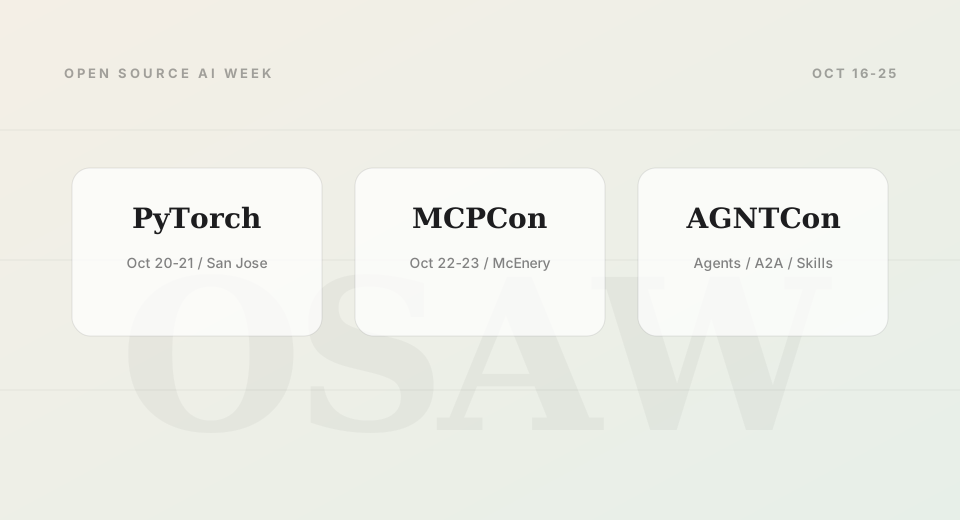
The Bay Area stacks a training conference and an agent-protocol conference into one week, and the public grid is longer than a roadmap review can absorb. Below is the week skeleton first, then the projects that clear three filters: the foundation named them, a keynote or a dedicated technical session exists, and the session is about an interface you might already depend on.
How the week is split
The Linux Foundation page dates Open Source AI Week to 16–25 October 2026 in the Bay Area. The flagships are PyTorch Conference North America (20–21 October, San Jose) and AGNTCon + MCPCon North America (22–23 October, San Jose McEnery Convention Center). The PyTorch page says San Jose and does not print the street address on the same page. Do not copy McEnery onto the 20–21 October dates.
The community site opensourceaiweek.com fills the same week with a 16 October opening, a 17–18 October hackathon on local open models, debates on the 19th, an awards night on the 23rd, and a close-out weekend. Those are independently hosted. A PyTorch or AGNTCon badge does not admit you to them.
| Date | What it is | Source |
|---|---|---|
| 16 Oct (Fri) | Opening, community events start | Community calendar |
| 17–18 Oct | Hackathon: local open models, on-device inference | Community calendar |
| 19 Oct (Mon) | Open debates. Arm Create runs the same day at The Tech Interactive, 10:00–21:00 PDT | Community calendar / AGNTCon side listing |
| 20–21 Oct | PyTorch Conference, San Jose. The 21st evening is a shared AI Community Bash | PyTorch Foundation / Linux Foundation |
| 22–23 Oct | AGNTCon + MCPCon at McEnery. The 23rd morning includes Welcome Back & Awards | Linux Foundation schedule, times in PDT |
| 24–25 Oct | Close-out community events | Community calendar |
Convert the clock before you staff a watch party
Both flagship grids are in PDT (UTC−7). Daylight saving is still on in California on 20 October 2026, so China Standard Time is 15 hours ahead. A 9:00 a.m. keynote lands around midnight the next calendar day in Beijing. Rooms and times are marked as subject to change.
What the two PyTorch days are for
The PyTorch Foundation page names six projects: PyTorch, vLLM, DeepSpeed, Ray, Helion, and Safetensors. It also prints 3,500+ attendees and 200+ talks and posters. 20 October is keynotes, sessions, the community expo, posters, and a Flare Party. 21 October repeats keynotes and the expo, then an AI Community Bash with DE LA SOUL shared with the AGNTCon crowd. The AGNTCon grid places that bash at 18:00–21:00 PDT on the 21st.
The keynotes worth putting on a calendar are the ones whose titles are already published. None of them have happened yet:
- 20 Oct, 9:15–9:30 — Alban Desmaison (Meta), PyTorch Updates. Core-maintainer release notes. Everything else sits on this.
- 21 Oct, 9:15–9:25 — Bill Jia (Google Cloud), Workload Fungibility in the Age of Agents. The abstract names torch.compile, FSDP2, TorchTitan, vLLM, SGLang, Helion, and says TorchTPU is publicly available in open source. Treat that as the published abstract. Check the repository tag after the talk.
- 21 Oct — Zhipeng Wang’s DeepSpeed keynote on scaling frontier-model training. Confirm the clock on the live grid. A sponsored demo’s length is not this talk’s length.
Which training and serving projects are worth tracking
The six names do not equally change next quarter’s deploy. The filter is whether a dedicated session is about an interface or about a case study.
| Project | Sessions you can match today | Question to check afterward |
|---|---|---|
| vLLM | An attention guide; KV transfer for disaggregated serving; tiered KV-cache offload; one model definition across accelerators without forks | Whether serving moves from “fill one machine” to split prefill and decode |
| Helion | CuteDSL and TPU backends, with the abstract saying the DSL suits agents; a second session on autotuning from Bayesian search to LLM-guided search | Kernel and compiler teams follow the repo. Application teams only need the note that agents are being aimed at kernels |
| DeepSpeed | The 21 Oct training keynote, plus a sponsored demo on expert and context parallelism for MoE fine-tuning | Keep the sponsored slot off the foundation roadmap. Training teams care about node count. Serving teams can stop at the keynote |
| Ray | A LinkedIn lightning talk on a heterogeneous, elastic training stack | The foundation named Ray, but the public grid is thinner than vLLM’s. Teams already on Ray should compare elastic scheduling |
| Safetensors | Lightning talk Faster LLM Serving Startup with fastsafetensors | Account for weight-load time separately from steady-state tokens per second. fastsafetensors is a load-path talk, not a seventh foundation project |
| PyTorch | Updates on the 20th; torch.compile, FSDP2, and TorchTitan in the 21 Oct abstract | Wait for APIs in the recording. Do not bump dependencies from a session title |
A sponsor list is not a foundation list
One Red Hat sponsored session names PyTorch, vLLM, llm-d, OpenShell, OGX (formerly Llama Stack), and Docling. Those names on a showcase slot mean someone is talking about them. They are not four new PyTorch Foundation projects.
AGNTCon and MCPCon share one grid
The Linux Foundation lists both as the Agentic AI Foundation flagship, 22–23 October, same building, 3,500+ attendees on the event page. Registration is for AGNTCon. MCP sessions sit on the same PDT grid under an MCPCon filter. It is not “AGNT in the morning, MCP in the afternoon.”
The 22 October Grand Ballroom order is published to the minute, and still marked as changeable:
- 9:00 — Angie Jones, welcome
- 9:05 — Mazin Gilbert, executive director, Agentic AI Foundation
- 9:15 — Manik Surtani, CTO, Agentic AI Foundation
- 9:25 — J.R. Storment, Tokenomics: token spend and intelligence per watt in the design review
- 9:30 — David Soria Parra, Anthropic, co-creator of MCP
- 9:40 — Bradley Axen, Building the Human-Agent Workplace, on how Block shares context, identity, and tool permissions between people and agents
On 23 October, 9:00 is Mazin Gilbert’s Welcome Back & Awards, 9:20 is Mark Collier (PyTorch Foundation), 9:25 is Thomas Dohmke (Entire), and 9:40 is Shadaj Laddad, Coding Agents need Deterministic Correctness. The abstract argues that review cannot keep up with agent throughput and that unit tests miss cross-service bugs. Hydro, the distributed simulator in that abstract, is a proposal inside the keynote. It is not a foundation project.
Six protocol names worth tracking
For application teams this week lives here, not in GPU training. The order is “does this change an interface you already call?”
| Project | What the grid says it is solving | How it meets work you already have |
|---|---|---|
| MCP | Co-creator keynote; OAuth for unregistered clients, protected-resource metadata, and enterprise authorization; server observability; publishing to PyPI and the Registry; the same server behaving differently in Claude and Cursor | The tool layer is still the one in MCP and data sources. After the week, diff the spec. Do not switch clients because a booth said so |
| A2A v1 | Tasks, Agent Cards, transport, extensions, and custom bindings; a second session uses it for framework-agnostic multi-agent systems | This is an agent talking to an agent. A single client calling tools is still an MCP problem |
| Agent Skills | Lizzie Siegle’s session treats a Skill as a repeatable capability the agent carries to the next task | That is not the same layer as Cursor Rules. See Skills and Rules |
| AI Catalog | One envelope for Skills, MCP servers, and A2A cards, plus .well-known/ai-catalog.json for mid-session discovery. The AGNTCY directory is described as the reference implementation | The session names clients such as Claude and Goose. That is the direction in the abstract, not a default that every client has already enabled |
| goose | Block’s open-source agent. The workplace keynote, plus a session on local code review with organizational context | Use it to compare permission models and sub-agents. It does not replace your inference server |
| Agent gateway | A sponsored short talk and a workshop: do not hand the agent an API key; inject credentials on egress. The gateway owns auth, limits, and traces | Same conclusion as minimal permission. Take the product name from the workshop notes. The pattern is usable before that |
WebMCP (register tools in the front end and reuse the existing login) and several orchestration proposals are also on the grid. They stay off the must-follow list until a keynote or a foundation name attaches to them.
What to verify after the week
People in San Jose and people watching the recording have the same follow-up: change the interface you already depend on, then decide whether a new repository belongs in the stack.
- MCP — Run the same tools once in Claude and once in Cursor. The grid already treats “passes in one client, falls apart in the other” as a normal failure. Pick servers from the MCP server list you already use. Do not add one per booth.
- Credentials — Check whether the agent process still holds a long-lived secret. The executable version of the gateway talk is: inject the credential when the tool call leaves, not when the prompt is assembled.
- Serving — If you expose an OpenAI-compatible API, log cold start apart from steady-state tokens per second. The vLLM sessions are about GPU clusters. On Apple silicon the local path is still MLX, Ollama, and Core ML. The hackathon theme “local open models” points at that side, not at moving vLLM onto a Mac.
- Long jobs — When the agent loop, a browser, and a compile share one machine, split the execution node from the editing node. The all-day layout is in the deployment note.
Watch order
On the 22nd, start with the MCP co-creator, then decide whether A2A and AI Catalog are your problem. If you are not in the room on the 20th and 21st, take the vLLM KV sessions and PyTorch Updates first. Helion and DeepSpeed depend on whether you write kernels or train.
Questions
Is Open Source AI Week the same event as PyTorch Conference? No. The week is the 16–25 October umbrella. PyTorch Conference is the 20th and 21st. AGNTCon + MCPCon is the 22nd and 23rd. The hackathon, debates, and awards come from the community calendar, and the tickets do not cross.
What time are the keynotes in China? The grid is PDT. 9:00 a.m. is about midnight the next day in Beijing. The bash at 18:00 on the 21st is about 9:00 a.m. in Beijing on the 22nd.
If we do not train large models, is PyTorch still relevant? The vLLM sessions and the Safetensors cold-start talk are enough. Leave DeepSpeed, Ray, and Helion to training and kernel teams.
MCP or A2A first? MCP. A2A is tasks and discovery between agents. While one client is the only caller of your tools, A2A is not the bottleneck.
ZavCloud Cloud Mac
The protocol moves in the cloud. The check stays on macOS.
An MCP server, a local model, and a long agent job can sit on a dedicated Mac mini: real macOS and its own IPv4, separate from the laptop you edit on.
View Cloud Mac plans