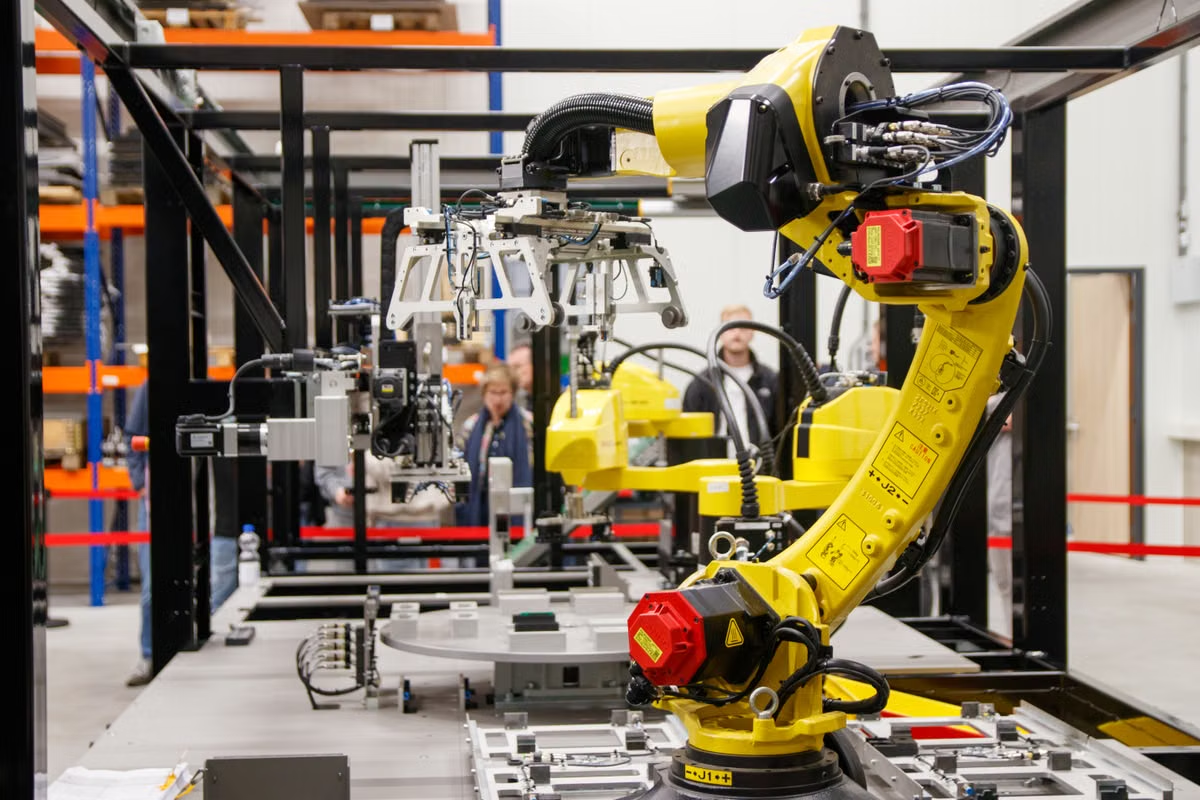
On June 30, 2026, Figure announced Figure 03 in a BMW factory context and described logistics work; that disclosure is evidence of a specific application, not proof of reliable operation across shifts, tasks, or factories (Figure’s announcement). Before you buy, require site evidence for task quality, continuous operation, safe collaboration, fault recovery, and maintenance. Treat anything not publicly documented as unverified until your own acceptance test confirms it.
This guide is for manufacturing automation leaders setting pilot-to-purchase gates.
It is for robot integrators translating factory work into acceptance tests.
It is for technical procurement teams separating a demonstration from repeatable deployment.
Last updated October 1, 2026. The evidence status below was checked against Figure’s announcement, BMW’s factory materials, and the cited standards and robotics assessment resources. The available disclosures do not establish long-term operating results for Figure 03 at BMW.
Start with the disclosed task, not the product promise
Figure’s announcement describes Figure 03 in a BMW factory setting and presents logistics work as the application. Use the Figure release to identify the disclosed scenario, then check BMW Group’s factory description for the context BMW itself has published.
Keep the site and deployment claims separate. BMW’s public material about humanoid robots in production in Germany is a relevant source for BMW’s broader activity, but it does not, by itself, prove that Figure 03 completed the same work at that site. Do not combine separate announcements into a single imagined pilot. In your procurement file, record the factory, robot model, task, date, and publishing organization for each source.
The current public record supports a limited conclusion: Figure 03 was presented in connection with a BMW factory logistics task. It does not establish a full production-cycle result, routine shift coverage, final safety approval for your site, or a successful rollout across multiple plants. These are separate questions that need separate evidence.
For the actual operation you are considering, draw the work as observable steps. A material-handling cycle might include locating an item, approaching it, grasping it, moving it, placing it at the destination, and confirming that the station can continue. This is a test design, not a claim that every step has been publicly verified for Figure 03. Mark each step as “shown,” “described,” or “not disclosed” when reviewing vendor material.
A video can show that a robot performed a visible action. It cannot establish how often the action succeeded, how exceptions were handled, or whether the surrounding production process stayed within its operating requirements.
Check task quality against the whole work cycle
The most useful acceptance evidence is not a clip of a successful pick. It is a record showing that the robot completes the defined work cycle under the conditions you actually expect: the real object, presentation, target location, surrounding equipment, and permitted variation.
Build the test from your process rather than from a vendor demonstration. Document what counts as a correct item, an acceptable placement, a recoverable miss, and a failure that requires human intervention. If the task includes sorting or moving parts, record whether the robot identifies the correct part, handles it without unacceptable damage, places it within the receiving area, and leaves the workstation ready for the next cycle. Do not infer those results from an announcement that only names the application.
For every test run, preserve the original task definition and the result record. Include successful completions, failed attempts, interruptions, and manual corrections. If the supplier reports a completion rate, ask for the denominator, test conditions, excluded events, and data collection method. A percentage without those details cannot tell you whether the measure reflects your actual work.
NIST’s robotic systems performance assessment framework is useful when you need a structured way to think about performance measures. Its agility assessment project also provides relevant context for evaluating how a robot handles changes rather than only repeating a fixed demonstration. Neither resource substitutes for acceptance testing on your line; use them to make your own measures more explicit.
What task did Figure 03 perform at BMW?
The public description identifies a BMW factory logistics application. That answers what type of work was presented, but not every operational detail a buyer needs. The available disclosure should not be treated as a complete task specification or as evidence that the robot performed all steps of a production workflow without assistance.
For purchasing, ask the supplier to map the disclosed task to your own process: input condition, object variation, destination, cycle boundaries, human handoffs, and completion signal. If the supplier cannot provide a testable task definition, you do not yet have a basis for comparing the demonstration with your production requirement.
Measure continuity beyond a successful run
A pilot may look successful while concealing the operating conditions that determine whether it can serve a shift. You need records showing what happens after a task interruption, a missed grasp, a blocked path, a changed item position, or a pause in production. If the robot needs to be repositioned, reset, or assisted, capture who performs that work and whether the line can continue safely.
Charging and handover also need direct validation. The public Figure 03 announcement does not establish continuous operation, charging behavior in your production setting, or how responsibility transfers between teams. Treat each as an open test item unless the supplier provides records for the relevant deployment and you confirm that the operating conditions match your site.
When you design the trial, define a representative observation window based on your production schedule and risk tolerance. Record start and stop times, productive time, downtime causes, interventions, restart time, and any effect on downstream stations. Do not compare a tightly supervised demonstration with an unattended or multi-shift requirement. They are different operating modes and should have different acceptance criteria.
A strong continuity record distinguishes robot downtime from process downtime. For example, a station may remain available while a technician clears an exception, or it may stop the next operation even though the robot remains powered. Those outcomes have different costs. Ask for event logs that let your team trace the full sequence instead of relying on a summary such as “available” or “working.”
Unknown is a valid evidence status. If public sources do not report shift duration, charging, task interruption, or recovery performance, record those fields as “not disclosed” rather than estimating them from a video.
Verify safe collaboration in your actual work area
Product safety design and factory-level safety validation are related but not interchangeable. A manufacturer may describe safety features, yet your site still needs to assess how the robot interacts with your layout, staff, operating procedures, and nearby equipment. A safety statement is not evidence that your particular cell or logistics route has passed an assessment.
Start by mapping where people can enter the robot’s working area, including normal movement paths and foreseeable exceptions. Test what happens when a person approaches, crosses a route, or needs to intervene. Confirm who can stop the system, how the stop is communicated, what conditions are required before restart, and who is authorized to resume the task. Add material jams, dropped items, blocked sensors, and loss of expected positioning to the scenario list.
Use the applicable risk assessment process for your jurisdiction and installation. ISO 10218-2:2025 covers safety requirements for industrial robot applications and robot cells. ISO 12100 provides a framework for machinery risk assessment and risk reduction. OSHA’s robotics standards guidance is a reference for U.S. workplace requirements. These sources help frame the review; they do not certify a specific Figure 03 installation or replace a site-specific assessment.
Keep the evidence trail concrete. Save the risk assessment, operating-zone plan, stop and restart procedure, training records, and test results for abnormal conditions. If a supplier says a feature prevents or detects a hazard, ask what condition was tested and how the result was recorded. Then verify the feature under your site’s expected conditions before treating it as an accepted control.
Check maintenance and repeatability before expanding
A pilot is not a deployment plan until you know how the system will be supported after installation. Ask who diagnoses faults, how your team reports them, what information the supplier needs, and how parts or replacement equipment are handled. Record support coverage and response commitments in terms your plant can operationalize; do not rely on an informal promise that help will be available.
Software changes need the same scrutiny. Establish how updates are proposed, tested, approved, scheduled, and rolled back if they disrupt the task. Ask whether a change can alter motion, object handling, safety behavior, or integration with line controls. If your production process requires change control, the robot supplier’s update path must fit that process rather than bypass it.
Expansion adds dependencies that a single-station demonstration may not expose. The next work area may have different lighting, floor conditions, object presentation, network constraints, or worker traffic. Your integrator should document which elements can be reused and which require fresh commissioning and validation. A successful task at one station does not prove identical performance at another.
| Evidence area | What public material may establish | What you should verify before purchase |
|---|---|---|
| Task | A described logistics application at a BMW factory | Full task boundaries, accepted output, exceptions, and performance on your parts |
| Continuity | The robot was presented in a factory context | Downtime, human interventions, charging, handover, and recovery records |
| Safety | Published product or project information | Site-specific risk assessment, stop and restart behavior, and staff procedures |
| Maintenance | Supplier support statements, if provided | Parts availability, fault escalation, update control, and documented response |
| Expansion | A named application or site | Repeatability at each proposed station and the commissioning work required |
This distinction matters for procurement comparisons. A vendor may provide a detailed demonstration but limited operational data; another may offer less polished video and stronger logs from a comparable task. Score the evidence quality and relevance to your site, not the presentation quality.
Use a graded evidence record for the pilot
A useful humanoid robot acceptance checklist keeps verified facts apart from assumptions. For each claim, store the source, date, location, robot version, task conditions, test owner, and evidence file. Then assign one of three statuses:
- Demonstrated: The evidence directly shows or records the defined behavior in the stated conditions.
- Requires site validation: The claim is plausible or documented elsewhere, but your layout, task, staff, or operating procedure has not been tested.
- Not established: The available material does not support the claim. Do not use it as a procurement assumption.
Apply the same status rules to public information and supplier submissions. An announcement is evidence that a company made a disclosure; it is not automatically an independent operational audit. A supplier test report may be useful, but you should still check whether its conditions match your task and whether it includes failures and interventions.
Your humanoid robot production-line deployment plan should also define a gate between pilot and expansion. Before committing to additional stations, require completed task records, acceptable exception handling, signed-off safety documentation, a support process that your team has tested, and a change-control path for software and task updates. Set the actual thresholds with operations, engineering, safety, and procurement; do not copy a generic target that ignores your line’s consequences of failure.
Decision conditions for moving from pilot to deployment
- If the complete task cycle is defined and repeatably recorded under your site’s expected conditions, then keep the task in the procurement evaluation. Otherwise, return to task scoping and do not compare supplier claims as if they describe the same job.
- If interruptions, human assistance, charging, and restart behavior are logged and acceptable to operations, then evaluate the proposed operating schedule. Otherwise, keep the system in a supervised pilot and collect continuity evidence.
- If safety owners approve the site assessment and workers can follow tested stop and restart procedures, then consider the validated work area. Otherwise, do not treat the robot as ready for routine shared operation.
- If maintenance escalation, parts handling, software change control, and rollback are documented and exercised, then assess expansion readiness. Otherwise, limit the scope to the supported trial.
- If the next station has been assessed for its own task and conditions, then plan a controlled replication. Otherwise, treat it as a new integration and validation project, not a copy-and-paste deployment.
What to verify after the demonstration
After a vendor demonstration, request the raw records behind the presentation: task definitions, event logs, interventions, restart details, safety test documentation, and maintenance history for the relevant application. Ask which outcomes were excluded from any reported performance result. If the answer is that no such records are available, document the gap and make it a condition of the next trial phase.
For any reported BMW result, check whether the source identifies the exact factory, task, operating period, and status of the deployment. BMW’s production announcement is relevant to BMW’s stated plans, but it should not be used as a proxy for Figure 03 performance unless it explicitly documents that link. This is the simplest way to avoid turning separate factory announcements into unsupported claims about a single robot’s operating record.
Plan the engineering environment separately from robot acceptance
Your acceptance result depends on the physical robot, integration work, controls, and site process. A remote development environment can support collaboration on code, test data, and deployment planning, but it cannot replace the robot’s on-site task and safety validation. Keep those workstreams separate in your acceptance file.
If developers need shared access to build or review software, first document the tools, access controls, data-handling rules, and any required connections to the robot or plant network. Do not assume a cloud Mac environment provides a connection to factory equipment or supports a particular robotics stack without confirming those requirements. You can review ZavCloud’s help resources when planning the service workflow, and compare available ZavCloud Mac cloud plans only if a remote Mac environment fits your development needs.
This is especially relevant when your team is split across locations: remote collaboration may help engineers share a controlled development workspace, while hardware access, safety tests, and production integration remain site responsibilities. If you need an environment for temporary development or evaluation, check the actual plan details and confirm compatibility with your tools before treating it as part of the robotics acceptance solution.
Make procurement conditional on evidence, not the video
The Figure 03 BMW disclosure is a useful reference point for a specific factory logistics application. It does not establish general suitability for your production line. Your purchase decision should depend on whether the supplier can show the whole task cycle, report continuity and exception handling, pass site-specific safety review, and support maintenance and controlled expansion.
If you are still identifying gaps, use the checklist to define what your pilot must prove before procurement. For short-term development or a temporary test workspace, renting a Mac through ZavCloud may be worth comparing with your current setup, but it is not a substitute for on-site robot validation. Your existing workstation may be less flexible for shared remote access; a cloud environment can add account, network, and compatibility checks; and buying dedicated hardware can leave you with capacity you no longer need after the evaluation. If you need a temporary Mac environment, review the ZavCloud plan options against your actual toolchain and access requirements.
ZavCloud Developer Infrastructure
Build Your Robotics Software Workflow with ZavCloud
Run macOS builds and automation on a dedicated Mac mini M4 without tying up your local workstation.
Connect through SSH or VNC and give your team a consistent remote development environment.