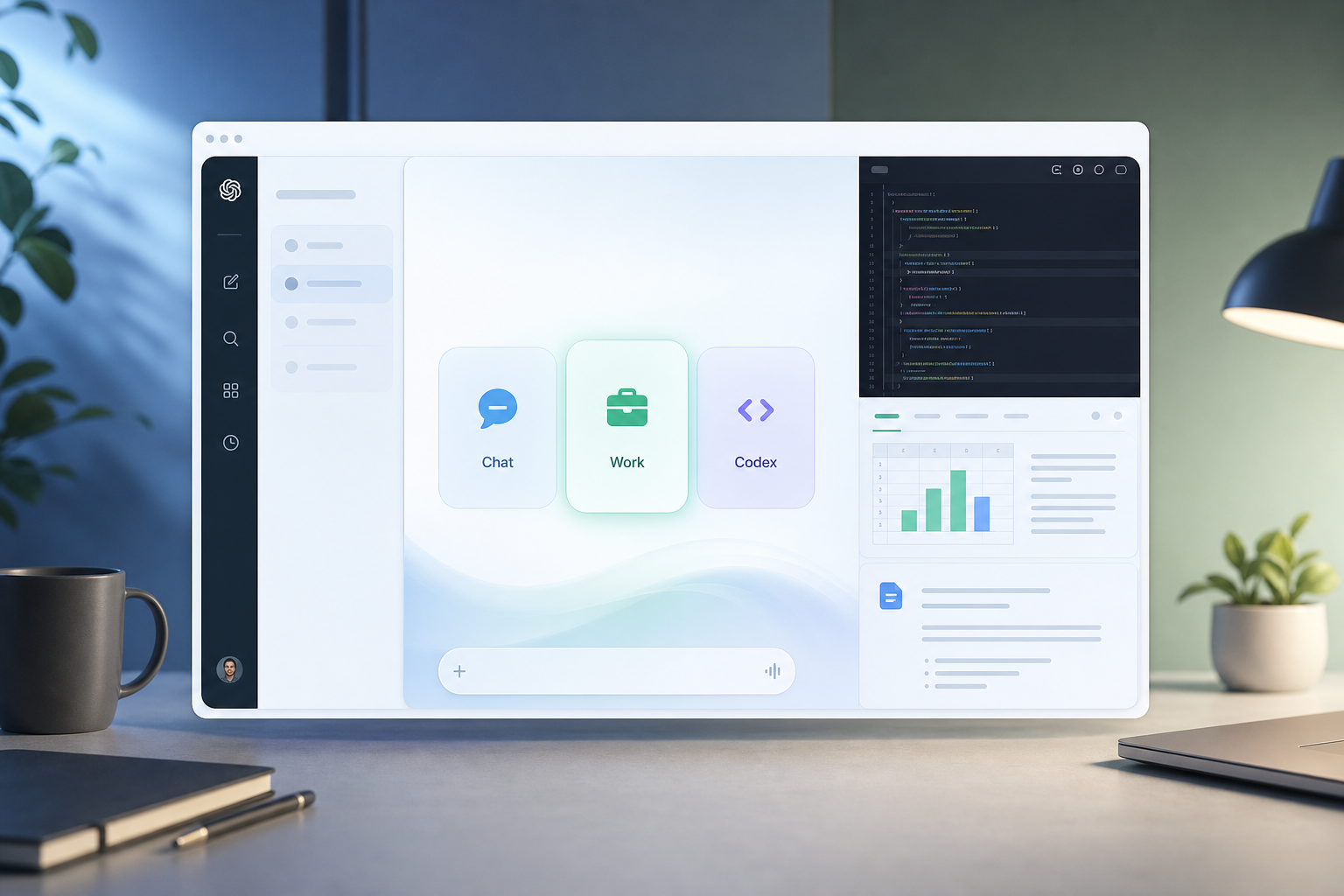
In one sentence: while everyone waits for Jony Ive's rumored "AI phone," OpenAI pulled out something palm-sized instead — the name says Codex, yet few people can immediately tell whether it is a model, a subscription tier, or a physical accessory. Over the past two weeks, teaser videos on social media have racked up nearly a million views, but the official line is just a slogan and a date. Below, we align everything confirmed and reasonably inferred as of July 14, 2026 along five threads: what it is, when it launches, what the hardware looks like, how it fits the Codex software stack, and the open questions still waiting for launch day.
If you already use ChatGPT desktop Codex mode or the Codex CLI, this article explains whether the pad is worth waiting for and how it differs from your current shortcut setup.
What is Codex Micro? Three misconceptions to clear up first
OpenAI Codex Micro is not a large language model, not a new ChatGPT plan, and not the screenless AI device from Jony Ive rumors. It is a compact programmable macro pad built by OpenAI in partnership with Canadian peripheral maker Work Louder, aimed at developers who use the Codex coding Agent daily — physical keys, a joystick, and a knob to trigger common actions, cutting down mouse clicks and memorized chord shortcuts across IDE, terminal, and ChatGPT.
OpenAI developer experience lead Dominik Kundel introduced the product at the AI Engineer World's Fair in San Francisco in June 2026. His line: a keyboard "designed to supercharge people's Codex usage." Business Insider, The Verge, 9to5Mac, and others agree on the framing: this is OpenAI's first physical product with an official logo, but the boundary is "accelerate Codex workflows" — not an on-device AI inference chip.
One-line definition
Codex Micro = a Codex-branded developer macro pad. It turns high-frequency actions like "accept diff," "switch Agent mode," and "paste context" into muscle memory — not a new AI capability or subscription tier.
What it is not
- Not a full keyboard — no QWERTY layout; it is a side macro console.
- Not a phone / Pin / wearable — unrelated to the consumer AI hardware track.
- Not a Codex gate — you can still use the CLI, IDE extensions, and desktop Codex mode without buying one.
Launch timeline and official statements
As of July 14, 2026, public information lines up on this timeline (sources: OpenAI Developers on X, AI Engineer World's Fair floor, and multiple tech press reports).
| Date | Event | Source reliability |
|---|---|---|
| 2026-06-29 | OpenAI Developers (@OpenAIDevs) posted a teaser video: "Your favorite Codex shortcuts are getting an upgrade," showing the Work Louder co-brand logo and marking July 15 | Official |
| 2026-06-29 | Live demo and packaging at AI Engineer World's Fair in San Francisco; attendee photos show "OpenAI 2026" on the side (where Creator Micro 2 reads "Work Louder © 2025") | Official demo + floor photos |
| 2026-06-29 | Dominik Kundel confirmed the product name Codex Micro and described it as strengthening the Codex experience | Official spokesperson (press reports) |
| 2026-06-29 ~ 07-14 | Teaser post neared 1 million views within 24 hours (Yahoo Tech / Inside AI, etc.); pricing, global availability, and custom mapping support not yet announced | Press reports |
| 2026-07-15 | Planned full launch: OpenAI says pricing and full specs will be revealed (whether sales start the same day is unclear) | Official teaser date |
On LinkedIn, Kundel wrote a line many hardware-minded developers will recognize: "Working on hardware has such different timelines" — hardware from concept to reveal runs far longer than model iteration. Codex Micro arrives as Codex weekly active users top 5 million (OpenAI, July 2026): "sell shovels after the software ecosystem matures," not hardware-first storytelling.
One diagram: why OpenAI shipped developer hardware first
With Jony Ive's consumer device still described by CFO Sarah Friar as "revealed before year-end," OpenAI chose a macro pad as its hardware debut. The logic chain looks like this:
Codex user scale → physical shortcut layer → ecosystem stickiness
Benefits for OpenAI
- No in-house supply chain — Work Louder already has Figma and other enterprise co-brand precedents
- Differentiation narrative vs GitHub Copilot, Cursor, and other software-only rivals
- Hardware hook for deeper IDE / driver integration later
- Hardware news heat while consumer Ive device timelines slip
Risks for users
- If OpenAI preset shortcuts are locked, programmability may lag pure VIA setups
- Desktop clutter — another device may not beat optimized keymaps
- Co-brand premium may exceed Creator Micro 2 list price
- Wireless / multi-OS compatibility still unverified until July 15
Hardware specs: confirmed and reasonably inferred
OpenAI has not published a full spec sheet. Cross-referencing floor units, the teaser video, and Work Louder's current lineup, the high-confidence hardware picture looks like this (inferred items marked):
| Item | Status | Notes |
|---|---|---|
| Form factor | Confirmed (visual) | Square macro pad; size and layout close to Work Louder Creator Micro 2 |
| Mechanical keys | Confirmed (press / floor) | 13 low-profile mechanical switches, programmable |
| Joystick | Confirmed | 2D analog stick — likely for layer switching or continuous parameter control (inferred) |
| Knob | Confirmed (press) | Clickable rotary encoder — common for volume / scroll / zoom mapping |
| Touch sensor | Confirmed (press) | Capacitive touch zone; on Creator Micro 2, used for fast layer switching |
| Mapping layers | Inferred (platform norm) | Creator Micro 2 supports 6 layers of independent shortcut profiles; Codex edition may keep or trim that |
| Connectivity | TBD at launch | Creator Micro 2 offers wired Base (~$144) and wireless Pro (~$174–199); unclear if Codex ships both |
| Config software | TBD at launch (critical) | Standard USB HID + VIA/QMK = cross-platform; OpenAI proprietary driver = tied to official integration pace |
The teaser showed rainbow lighting cycles matching Creator Micro 2 RGB; branding shifts from Work Louder to OpenAI, suggesting firmware or default keymaps may ship with Codex-specific actions — the most likely value-add over a generic macro pad, and the launch detail worth watching on July 15.
Who is Work Louder? Why this OEM
Work Louder is based in Montreal, with Italian-founder roots, and has long made niche input devices for designers and developers. Its Creator Micro 2 has steady YouTube and mechanical-keyboard community cred: compact, programmable, good for moving Figma / Premiere / IDE hotkeys off the main keyboard to a left-hand zone.
For OpenAI, choosing Work Louder over tooling from scratch has three practical reasons:
- Time to market — Kundel himself noted long hardware cycles; co-branding a mature SKU is the fastest path.
- Enterprise co-brand experience — Work Louder has done macro pads with Figma and other software brands; the "software brand + physical shortcuts" playbook is familiar.
- Audience overlap — Codex users and "developers who buy dedicated peripherals" align; no need for mass-market retail channels.
Pricing anchor (unofficial)
Creator Micro 2 lists in the US at roughly $144 (wired) to $199 (wireless). The Codex co-brand may cost more if it bundles custom firmware, extra keymap packs, or launch Codex credits — any specific number before July 15 is guesswork.
vs Jony Ive's consumer AI device: two completely different product lines
For over a year, attention has focused on OpenAI's work with former Apple design chief Jony Ive (via LoveFrom) on a "screenless AI device" — rumors cite cameras, microphones, ambient sensing, a pocket companion rather than a traditional phone. OpenAI CFO Sarah Friar said in 2026 it could be revealed before year-end, pointing to late 2026 through early 2027.
| Dimension | Codex Micro | Jony Ive consumer device (rumor / official tone) |
|---|---|---|
| Positioning | Developer productivity peripheral | Mass-market consumer AI hardware |
| Core capability | Physical shortcuts for Codex / system actions | Voice / vision / ambient interaction (inferred) |
| Launch timing | 2026-07-15 officially announced | Late 2026 ~ early 2027 (official vague window) |
| ChatGPT subscription | Peripheral is standalone; Codex features still depend on account and plan | Likely deep ChatGPT ecosystem tie-in (inferred) |
| Supply chain | Work Louder co-brand, small-batch niche | New category; bigger capacity and compliance challenges |
Conflating the two is the most common misread lately. Codex Micro is "faster for people already on Codex"; the Ive device is "AI on the go for people who never wanted a keyboard." In 2026, OpenAI is running a dual track: developer hardware first, consumer hardware later.
How it fits the Codex software ecosystem
In 2026, Codex is a cross-surface coding Agent brand, not a single app. For Codex Micro to "supercharge usage," it likely touches these surfaces (some inferred, pending official confirmation):
- ChatGPT desktop app · Codex mode — accept / reject diffs, switch model effort, jump between multi-repo projects (see our three-mode super-app guide).
- Codex CLI — trigger plan / apply, review sandbox output, paste context quickly (
~/.codex/config unchanged). - IDE extensions — common actions in VS Code / JetBrains inline Codex panels.
- Codex Cloud — remote Agent task state switching (if the driver supports browser or system-level shortcuts).
The key fork is integration depth:
- Shallow integration (USB HID + user mapping) — same as Stream Deck or any macro pad; high freedom, no ecosystem lock-in.
- Deep integration (OpenAI driver / preset profiles) — one-press actions only Codex understands (e.g. start an Agent turn with repo context); convenient, but tied to OpenAI's update cadence.
DevOps.com and TechTimes both note: July 15 must answer which path this is — that decides whether you are buying a logo or buying an ecosystem entry point.
Five questions still open on launch day
On the eve of launch, developer forums focus on these unknowns. Use the list as a checklist while watching the reveal:
| # | Question | Why it matters |
|---|---|---|
| 1 | Official price and whether Codex / ChatGPT benefits are bundled | Decides if the co-brand premium is worth it |
| 2 | Open custom mapping vs locked presets | Resale value and long-term maintainability |
| 3 | macOS / Windows / Linux support and wireless SKUs | Whether it covers where Codex CLI users actually work |
| 4 | Whether a proprietary driver or IDE plugin is required | Whether enterprise IT will allow it |
| 5 | Global availability and first-batch inventory | Buy at launch vs wait for import / secondary market |
Comparison: Codex Micro vs generic macro pads vs pure shortcuts
| Option | Typical cost | Pros | Cons |
|---|---|---|---|
| Codex Micro | TBD (anchor ~$150–200) | Codex-branded presets, community signal, left-hand ergonomics | Unknown premium; features may be replicable on a generic pad |
| Work Louder Creator Micro 2 | ~$144–199 | Same hardware platform, open VIA, buy today | No official Codex presets; you build keymaps yourself |
| Stream Deck / other macro pads | $80–300+ | Mature ecosystem, LCD keys, broad integrations | Larger footprint; no official Codex story |
| Keyboard remapping (Karabiner / AutoHotkey, etc.) | Free | Zero hardware cost, version-control friendly | No tactile feedback; complex layer switching still costs attention |
Skeptics often say: "Chord shortcuts solve this — why add another brick?" Fair — but a macro pad is not replacing your keyboard. It turns Agent actions you repeat dozens of times a day from "recall the chord" into "touch and go." Whether that pays for itself depends on how often you hit accept diff / switch context / rerun tests in Codex.
Who should wait and who can skip it
Worth watching the July 15 launch
- You spend 3+ hours daily in Codex CLI or desktop Codex mode with a stable workflow.
- You already use a macro pad (or a Figma co-brand unit) and know you like physical shortcuts.
- You are a creator / technical KOL who wants official Codex gear for streams or demos.
Safe to skip or wait
- You are still comparing Claude Code vs Cursor and have not committed to Codex.
- You mostly code on phone / iPad — desktop peripheral ROI is low.
- Company IT blocks unapproved USB HID devices — wait for driver and security docs.
- Budget-sensitive: Creator Micro 2 in stock + DIY keymaps may get you ~80% of the experience.
If you already run Codex Cloud + overnight CI on a Cloud Mac, the pad solves daytime interaction density — orthogonal to compute. The keyboard will not make Agents faster, but it might save ten mouse clicks.
Common misconceptions
- "Codex Micro = new model Codex-mini" — Micro refers to device size, not a model slug.
- "Keyboard bundles Pro subscription" — no official bundle news; beware secondary-market "includes credits" preorders.
- "OpenAI's first hardware = Ive phone early drop" — completely separate product lines; see comparison table above.
- "Codex gets throttled without it" — pure peripheral; no impact on API, CLI, or desktop features.
- "In stock on July 15 for sure" — official copy promises a "launch," not guaranteed same-day purchase or unlimited stock.
FAQ
Is Codex Micro an AI model? No — it is a physical macro pad for Codex-related shortcuts.
When does it launch? Full launch on July 15, 2026 (pricing and specs revealed the same day). A working unit was shown at AI Engineer World's Fair on June 29.
Is it related to Jony Ive's device? No — that is a separate consumer hardware line.
How much will it cost? OpenAI has not announced pricing. Creator Micro 2 suggests roughly $150–200; wait for official numbers.
Can I use Codex without it? Absolutely. Micro is an optional accelerator, not a requirement.
How does it relate to ChatGPT Work? Same ChatGPT super-app family, but Micro targets Codex coding workflows — not a dedicated peripheral for the Work office Agent (no official info suggesting otherwise today).
- Codex Bows Out, Work Takes the Crown! 2026 ChatGPT Core Updates Explained
- GPT‑5.5-Codex install and usage guide
- 20 Best MCP Servers to Install in 2026
- Claude Code vs Cursor (2026)
ZavCloud
Faster input on the desk, faster builds in the cloud
Codex Micro optimizes how your hands feel at the keyboard; multi-repo compiles, overnight tests, and long Codex Cloud jobs — rent a dedicated Mac mini M4 by the day so desktop Agents and your CI farm stay clearly separated.
View Cloud Mac plans